Case study · Mount Vernon · 2018–2020
Mount Vernon in AR: A First-Generation Smartglasses Tour of George Washington’s Estate
A 45-minute self-guided augmented-reality tour delivered through Epson Moverio smartglasses, produced in partnership with ARtGlass. Mount Vernon was one of the first historic sites in the U.S. to integrate wearable AR into its regular visitor offerings — a two-year experiment in interpretive storytelling that did things we simply could not do with a film, a panel, or a costumed interpreter.
The brief
Mount Vernon’s indoor mansion tour is the famous experience — the rooms, the objects, the colors of the walls. The outdoor estate is where the harder, richer history sits: the working farm, the gardens, the Potomac fishery, the lives of the people enslaved at the estate, and the deeper story of how the land itself has changed over 250 years. Most of that story can’t be told with a costumed interpreter and a fence-post sign. We wanted to find out whether augmented reality — layered live onto the actual landscape — could do it.
The experience
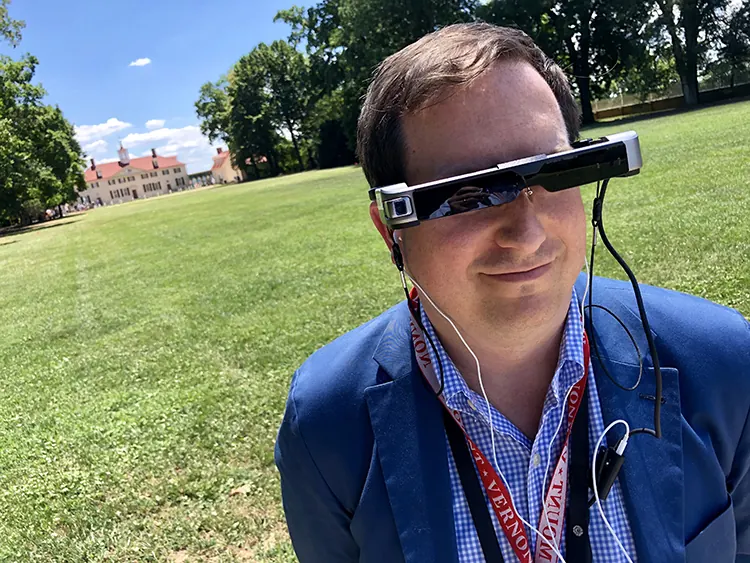
Visitors picked up a pair of Epson Moverio smartglasses at the Ford Orientation Center and were sent off on a self-guided 45-minute loop with six stops across the outdoor estate. At each stop, the glasses overlaid full-motion video, 3D models, holographic characters, and panoramic recreations directly onto the real landscape in front of you. The tour cost $12.50 on top of general admission and was weather-dependent — outdoors-only, on-the-move AR.
Among the things the glasses showed visitors:
- Holograms of George and Martha Washington appearing in the courtyard, narrating their arrival home.
- Holograms of enslaved laundresses at work in the south-side yard where they would have actually been — performed by actors on a green-screen stage and composited live onto the grounds.
- The HMS Savage, a Royal Navy ship, anchored offshore on the Potomac during the Revolutionary War — rendered in 3D over the actual river view.
- Time-lapse deterioration of the Mansion as it passed from owner to owner across the 19th century, before the Mount Vernon Ladies’ Association rescued it from ruin.
- 360-degree recreations of former buildings and gardens that no longer stand, anchored on the spot where they once stood.
- Young George Washington playing an 18th-century lawn game, dropped into the same field where it would have happened.
- George, an enslaved gardener at Mount Vernon, describing the role of the greenhouse, performed by actor Jamar Jones.
- Primary-source artifacts placed in their original context — the chair where it sat, the document over the desk where it was signed.
The augmented reality tour enables us to do things we cannot do every day: show primary sources next to places and objects, do large-scale reenactments of key events, and take guests back through time to show them what Mount Vernon looked like throughout Washington’s entire lifetime. — Matt Briney, VP of New Media, Mount Vernon (launch press release, 2018)


Watch the trailer
Mount Vernon in AR — trailer
A short film cut at launch showing the in-glasses overlays composited onto the live estate footage.
What we did
Original content, on a working AR stack
Mount Vernon’s staff wrote, cast, and produced the tour content. ARtGlass — the first company in the world to bring wearable AR at scale to the arts and cultural sector — provided the platform, the hardware deployment, and the on-glass runtime. Earlier ARtGlass deployments at European museums and archeological sites had reached more than 700,000 visitors by the time we launched; Mount Vernon was one of their flagship U.S. sites.
Production at full studio scale
This wasn’t a tech demo — it was a real film production with an AR runtime in front of it. The team included actors, filmmakers, 3D modelers, animators, and producers from across the Mount Vernon team. Hologram scenes were captured on a dedicated green-screen stage and composited onto live landscape footage. Live-action scenes — the Washingtons arriving home by carriage, the lawn games, the laundress yard — were shot on location.


Archeologically-accurate 3D models
Mount Vernon’s architectural and curatorial experts worked with ARtGlass’s 3D modelers on historical recreations of the Mansion and its outbuildings — the kind of precision that takes “3D for a museum” from approximate to authoritative. Mount Vernon’s team marked up render after render: this shingle line is wrong, this doorknob style isn’t period, the eaves should be deeper here. The models were built true to form, down to the doorknobs and shingles.

New stories the existing tour couldn’t tell
The single biggest payoff of the medium was that we could tell stories that the standard estate tour structurally couldn’t:
- The lives of the people enslaved at Mount Vernon — presented at the actual locations where they lived and worked, with named characters and primary-source accounts, not in a panel display elsewhere on the estate.
- Buildings and landscapes that no longer exist — brought back as 360-degree recreations on their original footprint.
- Time itself — the Mansion’s decay from Washington’s death through the 1850s, compressed into a few seconds and shown right where the visitor is standing.
- Events that happened off the visible grounds — the HMS Savage on the Potomac, the Royal Navy threatening the estate, Washington’s fishing operation in the river below.
The actor playing the enslaved gardener said it best:
Bringing to life the stories of those enslaved at Mount Vernon was an enriching experience. Standing on the grounds of where they lived made the experience even more visceral. — Jamar Jones, actor (in the “Mount Vernon in a New Lens” blog by ARtGlass CEO Greg Werkheiser, 2019)
From the field


What we learned
We ran the tour as a paid add-on for two years. The Epson Moverio glasses worked — daylight-readable, untethered, comfortable enough for a 45-minute walk — but the form factor was still early-generation: cabled, head-worn, and not yet at the “put it on, forget it’s there” comfort threshold that AR needs for true mass adoption. We learned a lot about how visitors actually behave with wearables on a guided tour: where they trip up, where they want to look away from the AR layer, how long they’ll keep the glasses on before needing a break.
More importantly, the content we produced has long outlived the hardware: the 3D models, the live-action plates, the hologram scenes, the narrative scripts, and the curatorial research that anchored all of it became reusable institutional assets — later folded into Mount Vernon’s virtual tour, classroom resources, and other digital experiences.
Why it mattered
The medium wasn’t the point. The new stories we could finally tell — about the land, the labor, and the lives Mount Vernon’s standard tour couldn’t reach — were.
The Mount Vernon AR tour was a working experiment in what wearable AR could do for a historic site when you took the technology seriously and treated the production at film-and-museum quality. We launched as one of the very first U.S. cultural institutions doing this in regular operation, and the lessons — what works, what doesn’t, what the medium is actually for — have shaped how I think about every immersive product I’ve been part of since.
Press: Mount Vernon launch release · “Mount Vernon in a New Lens” blog · PR Newswire · Northern Virginia Magazine · Preservation Maryland summit (AR/VR at historic sites)