Case study · Mount Vernon · 2020
When the Estate Closed, Mount Vernon Went Live: A Pandemic Pivot to Virtual Programming, Classroom Support, and Community Donation
In mid-March 2020, George Washington’s Mount Vernon closed to the public — during the single highest-revenue stretch of the year, when school-group bookings would have driven roughly 70% of annual visitation. Within days the digital team stood up a full virtual estate: daily livestreams five days a week, an expanded library of online learning resources for teachers and families, a new podcast for educators, and a public commitment to keep the public connected to the place even while the gates were closed. At the same time, the institution donated unspoiled food from its restaurant and gristmill operations and unused PPE from its paint and maintenance shops to local hospitals and first responders. When restrictions lifted in mid-June, Mount Vernon reopened in Level I outdoor-only operations with a published safety playbook.
The brief
Mount Vernon’s busiest season runs from March through early June — the months when school groups from every state and the surrounding region pour onto the estate, and when the institution earns most of its ticketing and ancillary revenue. When the building closed in mid-March 2020, all of that disappeared overnight, and with it roughly 70% of the year’s anticipated revenue. The question wasn’t whether to lay digital plans — everyone was — it was how to do it at the scale and speed the moment demanded, while keeping the institution’s public mission visible to the country sitting at home with their kids on Zoom.
Going live, five days a week
Within days of the closure we launched a daily livestream program on Mount Vernon’s social channels — five episodes a week, hosted by a rotating cast of curators, historians, gardeners, archeologists, and animal caretakers. The format was deliberately simple: a member of the staff, a corner of the empty estate, and a half-hour with the audience. Cherry trees in bloom; the sheep in their pasture; the smokehouse; the Slave Memorial; Washington’s tomb; the Mansion’s exterior. People watched in real time and brought their kids. The series ran throughout the closure and well into the reopening period and gave Mount Vernon a daily presence in households exactly as those households were doing their hardest work without ever leaving them.
An example program from the closure
One of the daily online programs produced while the estate was closed — staff bringing a corner of Mount Vernon to households in real time.
An online estate for the classroom
The single biggest pivot was for teachers. K–12 educators across the country had been thrown into virtual classrooms with almost no warning, and the most valuable thing Mount Vernon could give them was a curated, ready-to-use library of primary sources, lesson plans, distance-learning programs, and interactive tools that could be dropped straight into a Google Classroom on Monday morning. We rebuilt the website’s online-learning hub around exactly that.
What we opened up — or built from scratch — for educators
- Interactive learning & media: the Be Washington classroom version of the interactive theater experience; the Mount Vernon Virtual Tour as a remote field trip; the digital video series; the Lives Bound Together exhibit virtual tour; the George Washington Interactive Timeline; the Ask Mount Vernon video series; the Conversations at the Washington Library podcast; the Washington’s World interactive map.
- Digital primary sources: the museum collections, library special collections, archaeological collections, the Database of Enslaved People, the Richard H. Brown Revolutionary War Map Collection, a purpose-built Rules of Civility During COVID-19 resource, the George Washington Papers at the Library of Congress, the Financial Papers, the Mount Vernon Midden Project (crowdsourced archeology), Colonial Virginia Portraits, and Washington’s personal library catalogued on LibraryThing.
- Digital secondary sources: the digital encyclopedia; the full lesson-plan library; topic hubs on slavery at Mount Vernon, Building the Constitution, the Presidency, and Native Americans and Washington; historical performance and interpretation video.
- Online student learning: National History Day resources, interactive coloring pages, games and quizzes, grade-banded lessons (wheat farming, Washington’s travels, ice cream at Mount Vernon), Constitution quizzes, historic recipes, and digitized primary sources for independent student work.
- Distance learning & teacher PD: Mount Vernon’s live distance-learning programs delivered into individual classrooms; the “Under the Wine and Fig Tree” virtual happy hours for educators; the Teaching Slavery in Washington’s World symposium; Teaching with Mount Vernon professional development.
Browse the archived online-learning hub on the Wayback Machine →
Filming “Lessons on the Road” — Bobblehead George
To keep teachers and families connected to the estate while the doors were closed, we produced new educational video on-site — including the playful Bobblehead George “Lessons on the Road” series, filmed across Mount Vernon and the Fred W. Smith National Library in early 2021.


The educator podcast
The Washington Library’s Conversations at the Washington Library podcast launched a COVID-era episode early in the closure: “Teaching Online in a Time of COVID-19,” a conversation with Mount Vernon Student Learning Specialist Sadie Troy about how Mount Vernon’s education team was meeting teachers where they suddenly had to work. It became a sleeper resource for K–12 educators figuring out their own pivots in real time.
Conversations at the Washington Library — Teaching Online in a Time of COVID-19
An early-closure episode of Mount Vernon’s scholarly podcast pointed at K–12 educators, walking through the new online resources, the distance-learning programs, and the realities of teaching American history at a distance.
Food and PPE to the people who needed it
With the restaurant kitchens closed and the gristmill operations paused, Mount Vernon had perishable food stock that would otherwise have spoiled. We coordinated the donation of that food to local hospitals and first-responder units across the Mount Vernon and Alexandria area in the early weeks of the closure, when commercial food supply chains were under acute strain. At the same time, we audited the institution’s paint and maintenance shops for unused personal protective equipment — N95s, surgical masks, nitrile gloves, Tyvek suits — and donated what we had to area medical facilities at the very moment the national PPE shortage was at its worst. None of this was on anyone’s strategic plan; all of it was the right thing for an institution with the words “public good” in its mission to do in the spring of 2020.
Reopening: Level I, outdoors first
When Virginia’s phased reopening began, Mount Vernon went back online in Level I operations: outdoor estate only, Mansion interior closed, museum exhibits open at reduced capacity, capacity-limited timed-entry tickets, required face coverings indoors and where social distancing couldn’t be maintained, hand-sanitizer stations, clear-bag policy, and enhanced cleaning of high-touch areas. To give visitors a clear picture of what their visit would feel like, we produced a video safety briefing and published it on the reopening information page before opening day.
What was open · what was closed
- Open: historic area & grounds, gardens, outbuildings, Pioneer Farm, Forest Trail, Slave Memorial & Cemetery, the Washingtons’ tomb, museum exhibits (limited capacity), the Shops, takeaway food service, the food truck, the Piazza with adjusted seating, historic-breed animals on the trades and farm exhibits, ADA shuttle service at reduced ridership.
- Closed: the Mansion interior and tour, the Distillery & Gristmill, the Revolutionary War 4D Theater, the Be Washington Theater, the Hands-on History Room, the Wharf and Potomac cruises, the food-court pavilion, the Mount Vernon Inn Restaurant, the Washington Library.
Watch the safety video
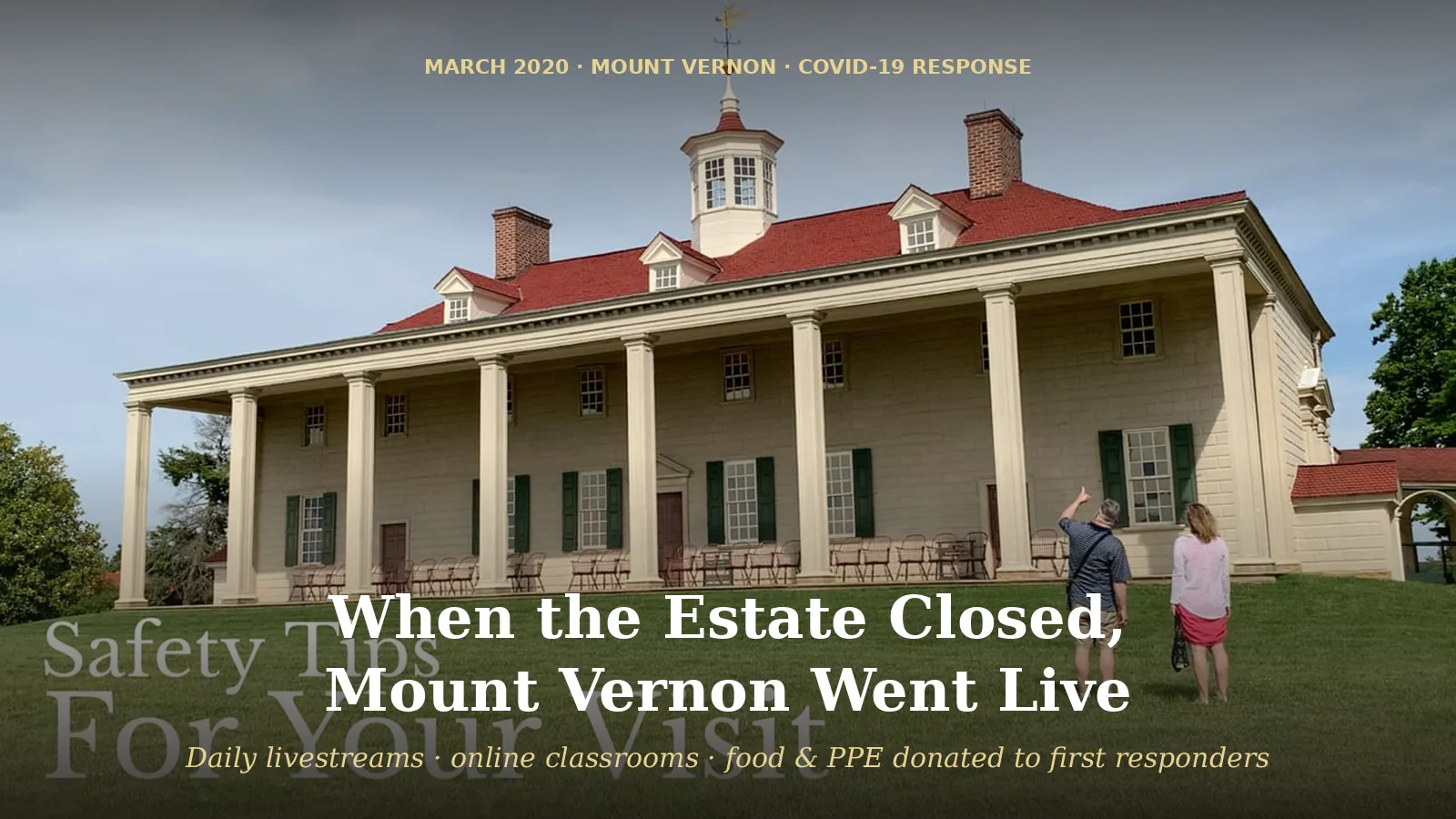
Safety Tips For Your Visit
The reopening orientation video. Published on the reopening information page before opening day so guests knew exactly what to expect at the gate — face coverings, social distancing, the clear-bag policy, hand-sanitizer stations, and which buildings were open or closed.
What we learned
- A historic site is also a content company. The hardest pivot was the easiest in retrospect — turn the institution’s actual storytelling expertise into something families and teachers could use from home, daily, for free. The audience was waiting for it.
- Teachers were the most important audience in the room. The biggest single payoff of the closure work was the consolidated online-learning hub. It survived the pandemic, kept growing afterward, and became one of the highest-traffic destinations on the site even after schools reopened.
- Outdoor-first reopening is a sustainable institutional posture. The reopening playbook — outdoor estate, capacity-limited timed-entry, clear protocols communicated up front — let Mount Vernon resume programming while the rest of the museum field was still arguing about whether to open at all.
- Mission shows up in the operations, not the press release. The food and PPE donations were the right thing to do regardless of whether anyone read about them. The fact that visitors and donors learned about them after the fact — from a single line in a newsletter rather than a campaign — was the right register for the work.
Why it mattered
The estate was closed. The institution wasn’t.
Mount Vernon spent the spring of 2020 doing what historic sites had been telling themselves for years they should be doing: turning the everyday expertise of the staff into a daily public-facing program, meeting teachers and families where they actually were, and using the institution’s physical inventory of food and protective equipment as a community asset. The financial hole was real and painful. But the audience growth on the digital side — livestream viewership, online-learning traffic, podcast listenership, virtual-tour minutes — carried forward into the reopening and reframed what kind of institution Mount Vernon could be on the way out of the pandemic.
Archive references: Online Learning hub on the Wayback Machine · June 2020 Reopening Information page · Podcast: Teaching Online with Sadie Troy
Media gallery


