Case study · Mount Vernon · 2014–2024
Mount Vernon’s Website Reborn as the Country’s Largest Open Classroom on George Washington
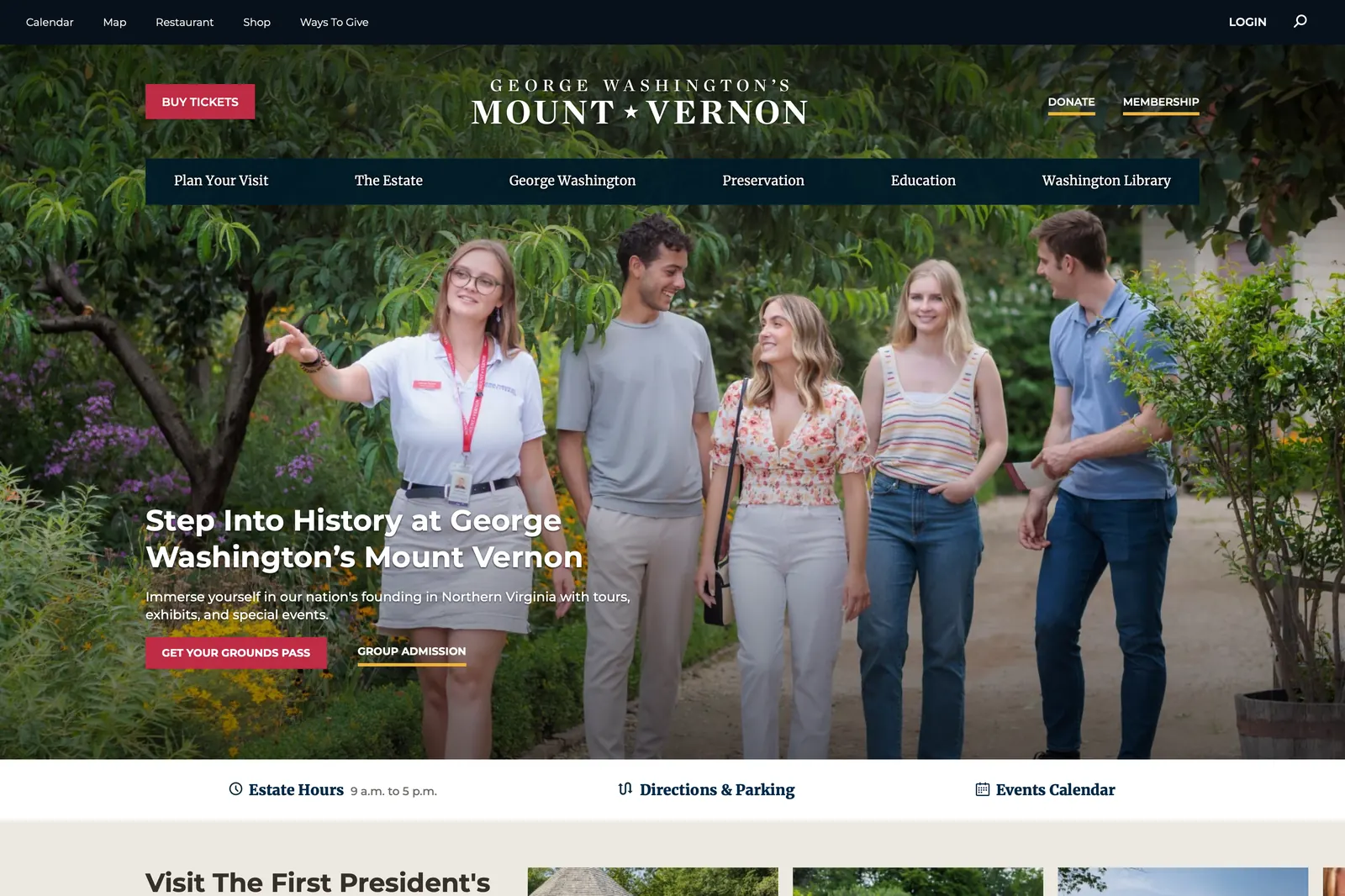
A ten-year content-and-SEO rebuild that grew the website from 2.5M to 8M+ annual visitors and 18M+ pageviews, and turned digital into a self-funding pillar of the operating model.
The brief
For most of America, Mount Vernon’s website is the first — and sometimes only — visit to the estate they’ll ever take. When I joined in 2014, the site was a serviceable brochure: hours, tickets, a few exhibits. The job was to turn it into something else entirely — the country’s definitive online resource on George Washington and the founding era, and a sustainable engine for visitation, e-commerce, membership, and earned revenue.
What we did
Content as the front door
Rather than build pages around tickets, we built them around topics — long-form, primary-source-anchored explorations of Washington’s life, the Revolutionary era, the founding, slavery at Mount Vernon, the landscape, the architecture. Each topic became its own SEO target. The site grew to more than 2,000 indexed pages across the digital encyclopedia, education and teacher resources, the digital collection, the Plant Finder, articles, events, and visitor planning. Over a decade, dozens of those pages claimed the top 2–3 organic search positions for their query and turned the site into the place teachers, students, journalists, and the curious actually land.

A revenue engine, not a checkout
We replatformed e-commerce on a custom stack that brought tickets, donations, memberships, and donor retention into a single system. We rebuilt the membership pricing model, hit a 30% lift in new members in year one, and grew online revenue from $1.1M to $8.6M over six years. Email got segmented, mobile got prioritized, and a centralized CRM tied the whole loop together.
Infrastructure that scaled with the audience
We migrated the entire web and database stack to AWS, cut operating costs ~35%, and gave the platform the headroom to keep up with growth. The website that opened in 2014 doing 4M visits closed out 2021 at 9M.


Why it mattered
Treating the website as the front door rather than the brochure changed the institution’s reach by an order of magnitude. The number of Americans who could say they’d “been to Mount Vernon” (in any meaningful sense) jumped from ~1M physical visitors a year to ~10M digital-or-physical. And the work became a model the rest of the historic-site sector started looking to: content depth, not feature breadth, is what turns a cultural institution’s website into a public good.