Case study · Edelman Public Relations · 2011–2014
Multiplier: Edelman’s Largest Client-Facing Technology Investment to Date
A complete rebuild of Edelman’s legacy Grassroots Multiplier® advocacy platform into a modern, multi-tenant Engagement Tool built on Salesforce’s Force.com and a Rackspace LAMP front-end. Designed around one question: how do you find people, mobilize them, and prove it happened? Shipped to 60+ client tenants spanning HP, Hyundai, Microsoft, BlackBerry, GE, Shell, Pepsi, the Embassy of Canada, the American Petroleum Institute, the Episcopal Church, and the National Health Council.
The brief
Edelman’s Grassroots Enterprise practice ran on Grassroots Multiplier®, a first-generation advocacy and engagement platform that had powered the firm’s public-affairs work for years. By the early 2010s the technology underneath it was aging: every campaign needed a custom build, the data model wasn’t plug-and-play across clients, and adding the next generation of features (social listening, mobile, intelligent data appending) required more bespoke work than the practice could afford to ship at scale.
The brief, internally framed as Multiplier 2 (and ultimately just Multiplier), was to rebuild the platform from the ground up: cloud-native, multi-tenant, API-driven, and architected so the next 60 client launches were configuration rather than custom development. The Multiplier FAQ described it at the time as “Edelman’s largest client-facing technology investment to date.”
The product positioning
Multiplier takes an existing supporter list and multiplies recruitment and engagement.— Multiplier internal positioning, Edelman University deck
The internal product framing reduced every engagement campaign to three questions, and built every feature in service of one of them:
Recruiting
How do you find people? Web forms, petitions, lobby letters, events, social-share actions, and offline data capture — all flowing into a single contact database.
Mobilizing
How do you get them to do something? Segment by attributes, frame messages per audience, deliver via email/social/web, and measure response in real time.
Proof
How do you know it happened? Cross-channel attribution, A/B testing, engagement scoring, and analytics that demonstrate impact to the client and the cause.
The engagement spectrum
Underneath every campaign was the same model of stakeholder commitment, drawn from years of grassroots-advocacy work. Multiplier treated audience identification as a first-class workflow: every supporter ran along a commitment curve from logical interest at the bottom to fervent participation at the top, and the platform’s job was to move the right people up the curve at the right moment.
- Logical Interest — someone who’s aware of the cause but hasn’t signaled commitment.
- Committed Interest — opened an email, read a post, recognized the issue.
- Passive Support — signed a petition, clicked a link, took one action.
- Active Support — sent a lobby letter, registered for an event, recurring participation.
- Engaged Participation — recurring lobby actions, friends recruited, in-person meetings.
- Fervent Participation — surrogate spokesperson, surrogate news source, embedded volunteer.
The feature set: a modular “blade” architecture
Where the legacy platform shipped as a monolith, the new Multiplier was designed as a stack of modular feature blades that could be turned on per-tenant. A small client got a CRM with a few forms; a large public-affairs client got the full advocacy and lobbying stack with social monitoring and data appending on top.
CRM & Database
Contacts, organizations, affiliations, custom fields per tenant, owner assignments, notes, attachments, activity history.
Email Marketing
Blast email, A/B testing, segmentation, deliverability tracking, partnered with ExactTarget for the heavy-lift sending infrastructure.
Website & Forms
CMS, embeddable forms (paste an iframe into any client CMS), goals & funnels, conversion tracking, website analytics.
Grassroots Advocacy
Letters to federal, state, and custom targets. Bill & vote tracking. ZIP+4 district matching. Elected-official lookups. Committee memberships.
Social Monitoring & Engagement
Conversation tracking, top-influencer identification, OAuth-based account linkage, sharing tools and analytics.
Reporting & API
Saved reports, cross-channel attribution, A+B test results, scheduled exports, and a full API layer for client-side integrations.
Multiplier Intelligence: data appending
One of the platform’s flagship differentiators was Multiplier Intelligence — a data-enhancement layer that took a thin contact record (name, email, ZIP) and silently appended a much richer profile from public and licensed third-party data:
- Geographic context — city, state, neighborhood, congressional district, state upper/lower district, metropolitan market, lat/long, and elected officials for the contact’s address.
- Social influence — social networks the contact belonged to, Klout score (this was 2012), network size, message amplification score.
- Lifestyle & interests — age, gender, marital status, home ownership and value, net worth, education, investments, credit-card type, magazine subscriptions, interest topics, charitable giving, employment.
For a public-affairs client, that meant a one-line submitted petition could turn into a fully-attributed contact you could segment, target, and route to a lobby team within a single afternoon.
What a tenant actually looked like
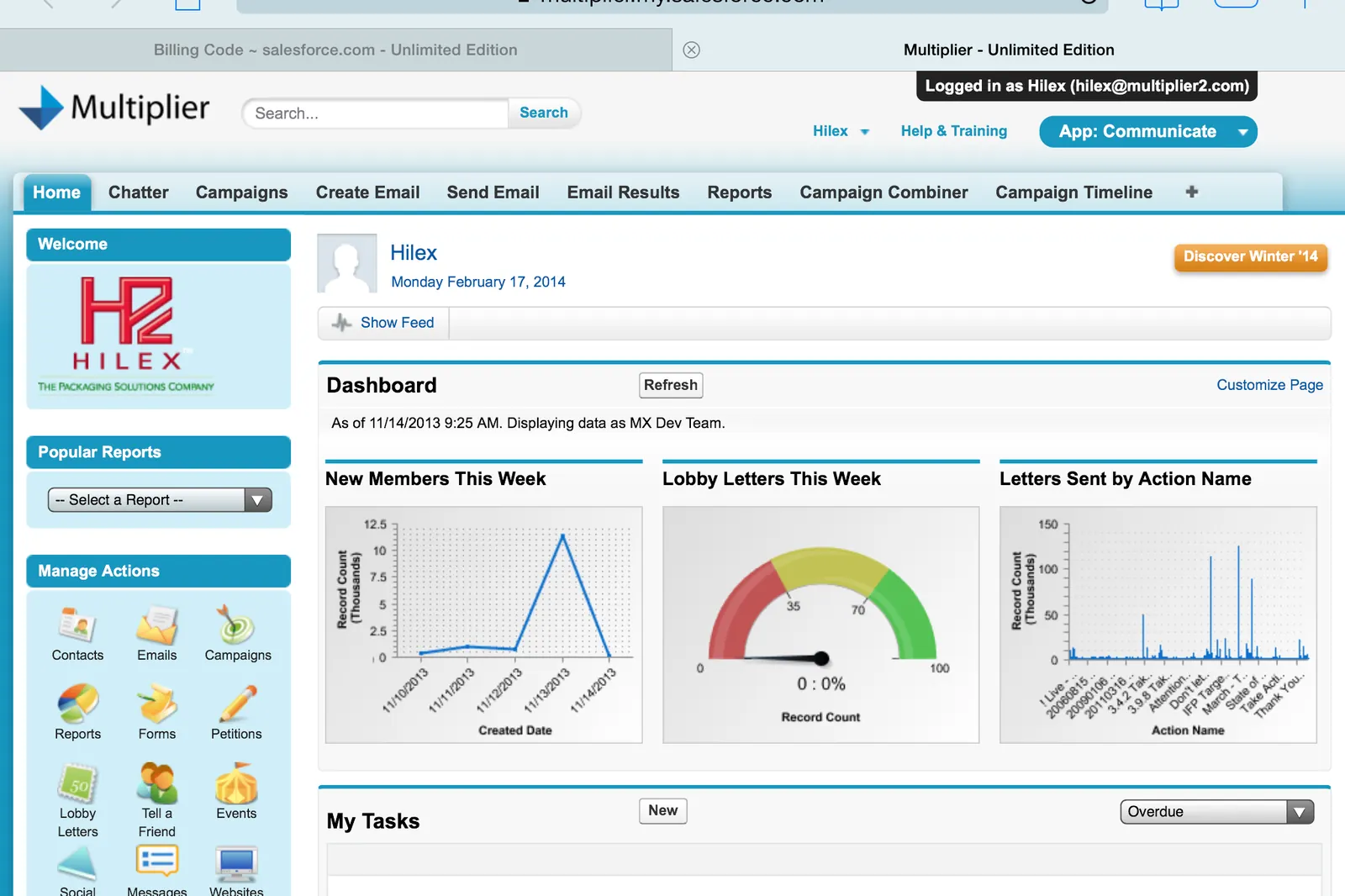
Below: an admin’s view of the Hilex client tenant, showing the Multiplier home dashboard — campaign tools across the top, an admin sidebar with all the action types Hilex had configured (Contacts, Emails, Campaigns, Reports, Forms, Petitions, Lobby Letters, Tell a Friend, Events, Social Advocacy, Messages, Websites), and a real-time dashboard of new members this week, lobby letters this week, and letters by action name.

The tech stack
Multiplier was a hybrid architecture — Salesforce for what Salesforce is good at (data, security, admin UI, reporting), and a custom Rackspace-hosted LAMP layer for everything Salesforce wasn’t (public-facing forms, advanced custom UI, content rendering).
- Force.com (Salesforce platform) — tenant data model, admin UI, reporting, data management, security, user permissions.
- Rackspace Cloud Sites (PHP + MySQL, LAMP) — all public web requests, form rendering, embeddable assets for client CMSes, temporary data storage, advanced UI.
- SOAP API bridge between the two layers, with batch processing in chunks of 200 records, triggered by cron on Rackspace.
- Beanstalk Git for revision control, with four environments — local development → remote development → remote staging → production — mirrored across the Salesforce Sandbox ↔ Production split.
- ExactTarget (now Salesforce Marketing Cloud) as the email-delivery partner for high-volume sends.
Case studies from the portfolio
The Partnership — financial-services thought leadership on the DC Beltway
A financial-services-industry client wanted to build an email list of the Beltway’s most influential individuals in financial services and engage them on key messages. Multiplier did the website-and-email integration that gave the team performance tracking from inbox to web page, the A/B-test reporting that improved content/subject-line response, and the Intelligence layer identified roughly 10% of recipients as political donors — with party preference. The campaign tuned for senior Hill-staff readers (for the lobby team), industry promoters (for content sharing), and issue champions (for follow-on requests), and delivered results 5× industry standard.
Rogers Wireless — consumer launch buzz pivoting to advocacy
Rogers Wireless used Multiplier to build consumer buzz around a new product launch, then pivot the same database into advocacy work. The platform integrated website, advertising, and email behind a single contact store, tracked performance from digital ads → web page → inbox → in-store events, and used Intelligence to map regional customer and prospect densities — informing where to schedule in-store events.
PepsiCo — tracking the top 100 influencers
PepsiCo wanted to know what the most influential voices in its category were saying, increase positive coverage, and identify conversation trends. Multiplier built the Pepsi Top 100 Influencers list, monitored their conversations in real time, and gave the PepsiCo team a single dashboard for inserting Pepsi into the trends they wanted to ride — and course-correcting off-message Pepsi chatter. The work generated alerts across social and traditional media, fed into Multiplier’s segmentation, and let PepsiCo pivot the same audience into other campaign actions.
Connect2Canada (C2C) — the Embassy of Canada’s diaspora platform
The Embassy of Canada used Multiplier as its Connect2Canada member platform — a CRM for Canadians and Canada-watchers in the U.S. with custom fields for Contact Interest Areas (U.S.–Canada border, travel, trade & investment), Interested Actions (“spread the word,” “connect and socialize”), Birth Province, and newsletter subscriptions (Canada Watch, Monitor, NewsCan). The Embassy ran trainings on the platform out of Washington, with on-call support from the Edelman team in Arlington.
HP, Hyundai, BlackBerry — the named-brand engagements
Inside Multiplier’s tenant list were some of the largest corporate-communications deployments of the era: HP’s HPNN internal news platform (commissioned by Meg Whitman during a period of rapid leadership change), Hyundai’s 24-hour fuel-economy reimbursement tool (built ahead of an EPA hearing — visitors entered a VIN, the tool computed the MPG discrepancy factoring in state-specific fuel prices, and Hyundai offered 120% cash value as fair compensation), and BlackBerry RIM’s B2G site for federal buyers. Each was a different shape; each ran on the same platform.
Training & rollout
Selling and operating a platform like Multiplier internally required as much training as the technology did. The rollout ran on two layered tracks:
- Edelman Ambassador’s Training — a 2-day, internal-staff certification covering selling Multiplier, architecture, navigation, action creation, reporting/analytics, ExactTarget email, Intelligence appending capabilities, API access, social monitoring, and pricing. The first cohort included a Friday-afternoon ExactTarget session and an API/developer documentation deep-dive.
- Client Training — half-day to full-day sessions for the client-side admins on a new tenant. Topics: navigating Multiplier, website integration, the client’s custom actions and fields, reporting, sending emails, social monitoring. Recurring clients like the Embassy of Canada and ASCD received returning trainings as their teams turned over.
Why it mattered
Edelman’s largest client-facing technology investment to date.— Multiplier internal FAQ
Multiplier was the platform that let Edelman’s public-affairs and consumer-marketing practices ship 60+ client tenants on the same architecture — with the data, advocacy, social, and intelligence capabilities those clients increasingly expected, without rebuilding the wheel for each engagement. It taught me, hands-on, how a services firm builds proprietary technology that earns its place at the center of client relationships rather than competing with them — and how to design a multi-tenant platform that scales by configuration, not custom development.