Case study · Mount Vernon · 2018–2020
War and Peace in Miniature: A Touchscreen Kiosk for 30 Rare Early American Medals
Mount Vernon’s temporary exhibition War and Peace in Miniature: Medals from the American Numismatic Society displayed 30 silver, bronze, and copper medals on loan from the American Numismatic Society — each one no more than two inches across. We built an in-house touchscreen kiosk that sat next to the case and let visitors do the one thing the physical objects couldn’t: examine them up close, in zoomable high resolution, front and back, with the inscriptions and symbolism unpacked.
The brief
The objects were unbelievable. Eleven of the medals were from the Comitia Americana series — the first decorations Congress ever awarded, struck in Paris by master engravers to honor American commanders of the Revolution. The very first Comitia Americana medal went to George Washington for relieving the siege of Boston in March 1776, three months before the Declaration of Independence. Six were “Indian Peace medals” from Washington’s administration. Three were the “Seasons” medals designed by John Trumbull. The remaining medals tied the rest of the story together: the Libertas Americana medal that Benjamin Franklin commissioned to celebrate Yorktown, the Diplomatic Medal of the United States, the Fidelity Medal awarded once and only once for the capture of Major John André.
And every one of them was smaller than a silver dollar. The engraved detail — classical allegories, bust portraits, vivid battle scenes filled with cannon and charging horses — was the whole point of the medal as an art form, and the whole thing that visitors physically couldn’t see standing in front of the case.
What we built
A touchscreen kiosk, developed in-house, mounted next to the display case. The interaction was deliberately simple, because the medals deserved to be the center of attention:
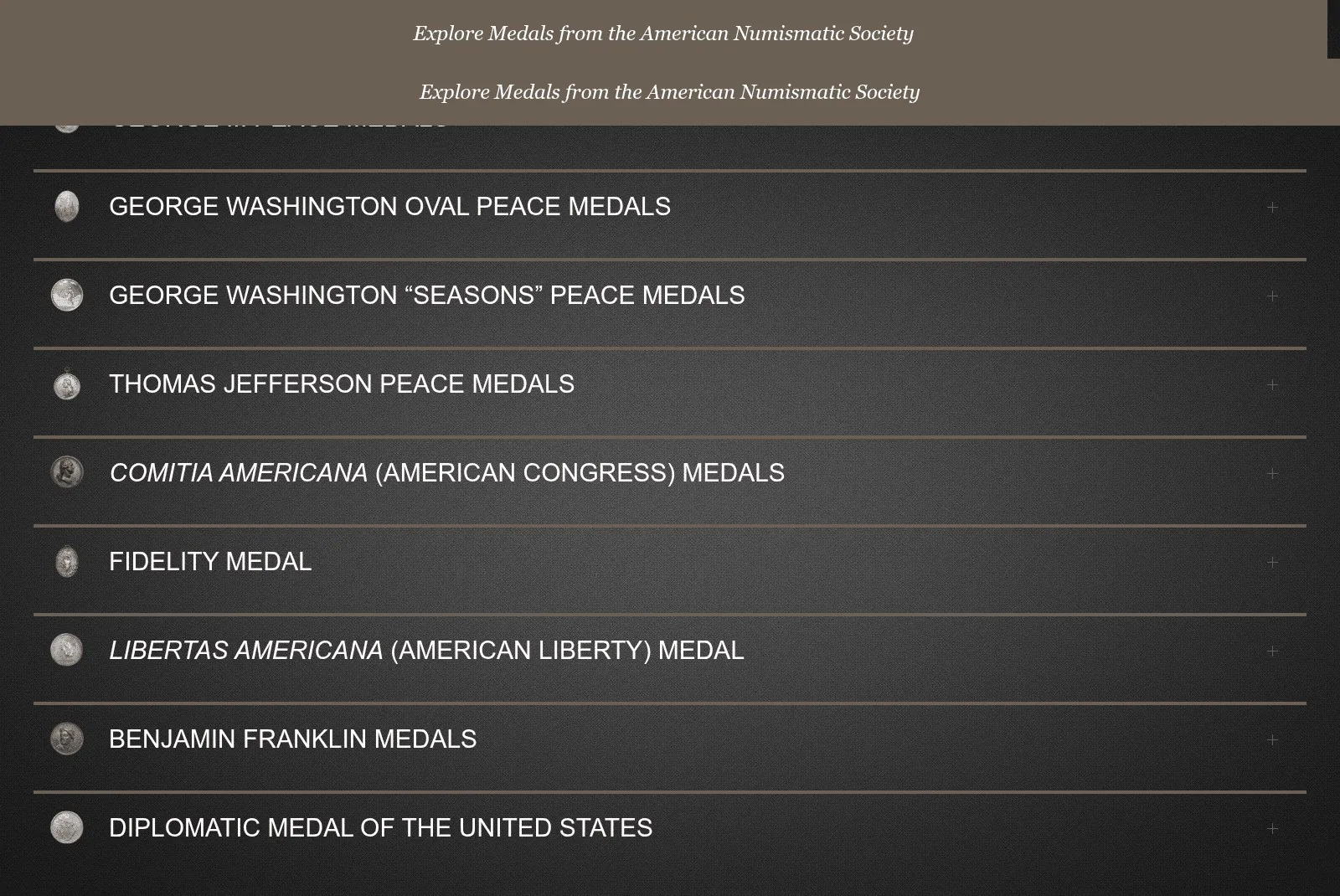
- Pick a category. Nine thematic groupings — George III Peace Medals, Washington Oval Peace Medals, Washington “Seasons” Peace Medals, Jefferson Peace Medals, the Comitia Americana series, the Fidelity Medal, Libertas Americana, the Benjamin Franklin medals, and the Diplomatic Medal of the United States — each with a short curatorial essay framing the politics, art, and diplomacy.
- Pick a medal. Tap any medal in the category to open a detail view.
- See both sides, full-bleed. High-resolution scans of the obverse and reverse, zoomable down to the engraver’s tool marks. For some medals, surviving sketches by the engravers (Augustin Dupré, Pierre-Simon-Benjamin Duvivier, Nicolas-Marie Gatteaux) were included alongside the finished objects.
- Read the details. Material (silver / bronze / copper / lead trial impression), date, place of manufacture, engraver, ANS accession number, and a paragraph or two on what the imagery is doing.

Three medals worth standing in front of
George Washington Before Boston, 1776
The first decoration Congress ever authorized. Pierre-Simon-Benjamin Duvivier engraved the dies in Paris; Washington is depicted in classical profile on one side, with the British evacuation rendered as a battle allegory on the other. Washington owned the only known original set of silver Comitia Americana medals at the time of his death.

Libertas Americana, 1782–1783
Benjamin Franklin, then American minister to France, commissioned this medal to mark the decisive Yorktown victory. The reverse depicts the infant Hercules — the United States — strangling the serpents of the British armies at Saratoga and Yorktown, while Athena (France) stands guard. It’s considered one of the masterpieces of medallic art.

Large George Washington Peace Medal, 1793
Because no American mint yet had the technology to strike large dies, the United States’ earliest Indian Peace medals were hand-engraved one at a time on thin plates of rolled silver. Every medal is unique. Washington’s administration replaced the British king’s portrait — standard on European peace medals — with an image of a Native American leader sharing a peace pipe with a uniformed figure of the President, an attempt to adapt monarchical diplomacy to republican ideals.

How we built it
In-house, on a static stack
The kiosk is a pure client-side web application — HTML, CSS, JavaScript, and a folder of TIFF-derived PNGs from the ANS’s scanning department. There’s no backend, no database, no CMS. The curatorial copy lives in the source. The whole thing deploys to GitHub Pages and runs offline on the kiosk hardware once cached, which is exactly what a gallery touchscreen needs: predictable, never-down, no “the internet is being weird today.”
Built around the images
Every medal has an obverse and reverse scan, and a generous interaction budget for zoom. The single most important thing the kiosk does is let you get closer to the object than the gallery rope will allow. Everything else — the categories, the essays, the engraver attributions — is in service of that.
Curatorially serious
The text on the kiosk came directly from senior curator Dr. Susan Schoelwer and the curatorial team. Each category opens with an essay placing the medals in their political moment — the 18th-century diplomatic gift economy, the failed Jeffersonian plan to send Comitia Americana sets to “each of the Crowned heads in Europe,” the unsuccessful attempt to introduce new imagery into Native American diplomacy, the Lewis and Clark Expedition handing out nearly five dozen Seasons medals to Plains and Rocky Mountain nations whose ways of life had almost nothing to do with the farming scenes depicted on the medals themselves.
Why it mattered
You can’t lend the visitor a magnifying glass. You can lend them the touchscreen.
Medals are perhaps the least known and least appreciated art of early America, exactly because of their scale. Without a digital interpretive layer, this kind of exhibit ends up being a row of beautiful objects in a case with no way to read them. The kiosk fixed that — it made the engraver’s craft accessible at the level the engravers actually worked at, and it gave the curatorial team a way to publish a full mini-monograph’s worth of context without papering the gallery walls with text panels. It also outlived the exhibit: the kiosk app is still online, still public, and still does its job seventeen months after the loan was returned to the ANS.
Press & sources: Mount Vernon press release · The E-Sylum (Numismatic Bibliomania Society) · American Numismatic Society