Case study · Theodore Roosevelt Presidential Library · 2024–2026
$98M in Earned Media: Opening a Presidential Library to the World
A $450 million institution opened on July 4, 2026 in a North Dakota town of about 130 people, two and a half hours from the nearest mid-size airport. The job wasn’t announcing an opening. It was convincing a national assignment editor that the Badlands were worth a crew.
The brief
Most institutions launch into an existing news market. This one didn’t. Medora, North Dakota has a permanent population of about 130 people. The nearest commercial airport is thirty-five miles away and the nearest large one is a two-hour drive. Every national outlet that covered this opening had to decide to send a crew somewhere expensive and remote, weeks in advance, on the strength of a pitch.
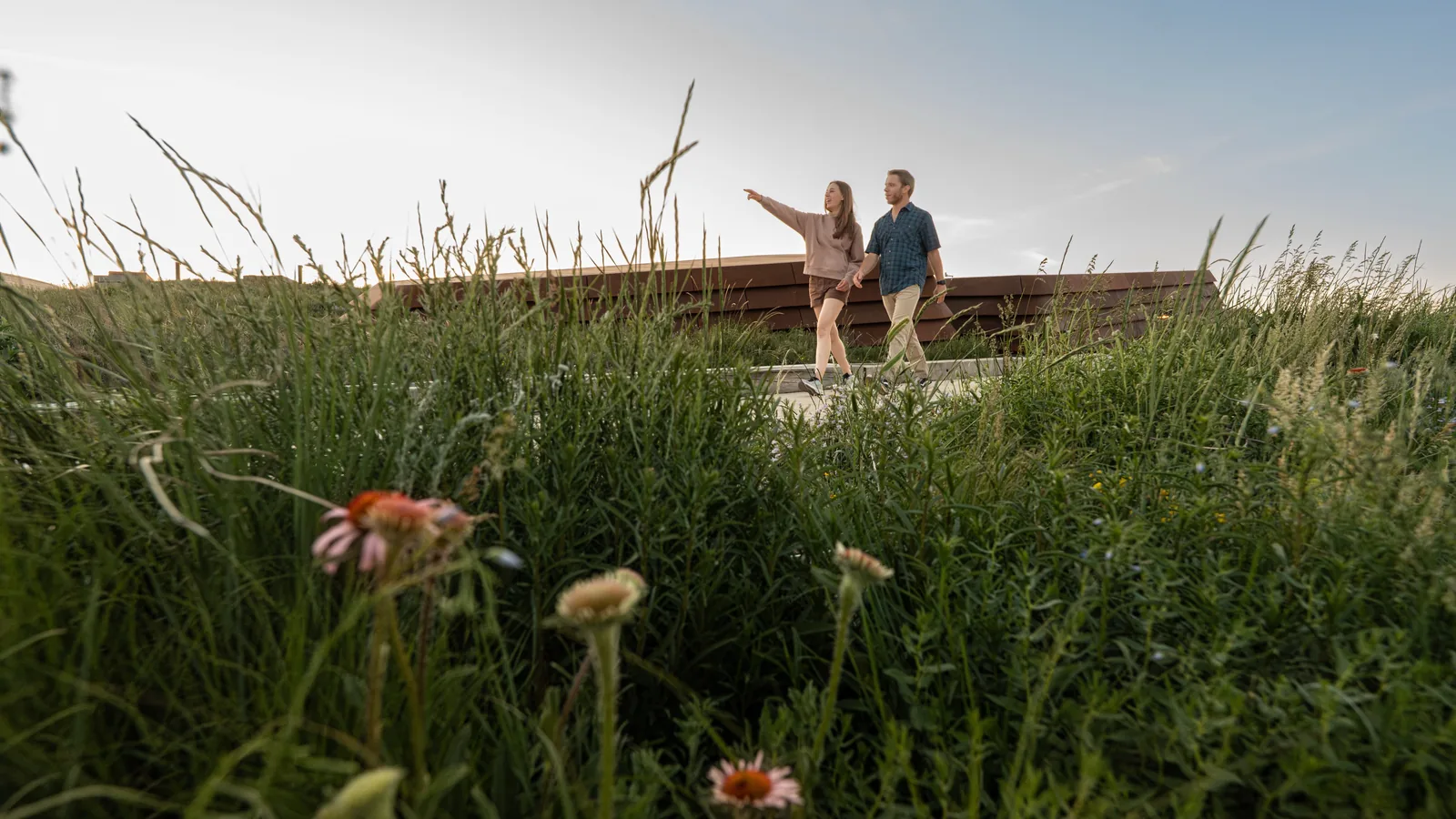
What they would find when they got there was, admittedly, worth the trip: a Snøhetta-designed building of rammed earth and mass timber under a planted roof, on a 93-acre site beside Theodore Roosevelt National Park, pursuing full Living Building certification. The pitch was never the problem. The distance was.
So the work wasn’t writing a release. It was building the infrastructure that made saying yes easy — and then removing every obstacle between a journalist on deadline and a finished story.
Earned media value provided by Javelin and verified against Nielsen figures from Critical Mention. Placement count is the Library’s public clips index — 312 documented items across ~147 outlets, July 2023 to August 2026. Visitor figure reported by the Library, July 23, 2026.
Every tile links to the piece. The full index — 312 placements across roughly 147 outlets, tracked from groundbreaking in July 2023 — lives on the Library’s In the News page.
Building the press center as infrastructure
The Library’s press center was built as a working tool rather than a page that exists because institutions have one. It does three things, and each removes a specific point of friction.
A press kit written to be quoted from
The backgrounder was written, in its own words, “to be quoted from directly, fact-checked against, and navigated quickly under deadline.” That sentence is the whole design brief. A reporter filing at 4 p.m. does not want a brochure. They want the founding dates, the square footage, the architect, the funding structure, and the correct spelling of Snøhetta, in an order they can scan.
The practical test of a press kit is whether the facts in published stories match the facts you supplied. Across the opening coverage, they largely did.
A photo library with no gatekeeper
The Library’s Acquia DAM press portal is embedded directly in the press center and open to the public — no login, no request form, no email round-trip. By opening weekend it held more than 2,400 assets across eighteen galleries, including 545 photographs from the July 4 ceremony alone, 116 from the drone show, and 317 from the Campfire & Prairie Talks.
An editor closing a page at 9 p.m. Eastern is not going to email a communications office and wait. Publishing the art up front is what converts a story that ran with one wire photo into a story that ran with a gallery.
The crew that filled it
A photo portal is only as good as the pipeline behind it. Through opening week that pipeline was a managed operation: three Getty photographers, two photo editors, an in-house photographer, a full documentary team, and four interns working as production assistants working the campus simultaneously across the presidential dedication, the Founding Benefactor Days, the ceremony, the talks, and the drone show.
The photo editors are the part most institutions skip, and they are the reason the whole thing worked. Shooters produce volume — thousands of frames a day across six events. Without editors embedded in the operation, that volume sits unculled while the news cycle moves, and the institution ends up publishing its best images two days after anyone needed them. With them, selects were caught, captioned, and pushed to the portal while the story was still live.
Getty coverage did something the portal alone couldn’t: it put the Library’s imagery onto a wire that thousands of outlets already subscribe to, reaching newsrooms that were never going to send a crew to western North Dakota and would otherwise have run the story with no art at all — or not run it.
And four interns
The other people on that riser were four interns, shadowing as production assistants through the whole of opening week.
The instinct on a week like this is to bring in only people who have done it before. That instinct is wrong, and it’s wrong for a reason worth naming: opening weeks are the only time an institution runs a full-scale press operation, so if you don’t train people during one, you never train them at all. There will not be a second grand opening.
They worked a national press pool, a Secret Service perimeter, a live network riser and a sold-out ceremony — the kind of week most communications professionals wait a decade to see once. It cost the operation almost nothing and it is the part of the week I’d least want to have skipped.

One named human
Media inquiries route to a person with a name, a title, and a direct address — not a press@ alias. For a first-time institution with no press relationships, being reachable is not a small thing. It is most of the job.


The embargo window did more work than opening day
Accredited journalists were invited to the campus for press tours before the Library opened, and pre-record interviews began as early as March — four months out. That single decision shaped the entire coverage arc.
Before the embargo: national television in April
The window opened earlier than the embargo did. On April 15, 2026 — two and a half months before opening — ABC’s Good Morning America broadcast live from the Library as part of its 50 States in 50 Weeks series, with the Theodore Roosevelt Presidential Library representing North Dakota. Four segments ran that morning.
The building was a construction site. There were no galleries to walk, no exhibits installed, no visitors to film. Which is exactly the problem worth describing, because it is the one every institution faces before it opens: you have to offer a morning show something other than the thing that isn’t finished yet.
What we offered instead was the place. The crew scouted the day before — a hard-hat walkthrough, the roof, pre-interviews on site — and on air the story ranged across Medora’s historic main street, the Chateau de Morès, and the national park, with Library staff, Park Service rangers and townspeople assembled in the dark as the live audience. A national morning show didn’t come to see a museum. It came to see a town that had been waiting a hundred years for one.


That last image is the underrated mechanic. National attention is itself a local news story, and regional outlets will cover the arrival of a network crew as an event in its own right. One live segment produced a front page in the nearest daily — and the two together told western North Dakota that something real was happening, ten weeks before we asked anyone to buy a ticket.
Dividing one story into non-competing exclusives
This is the part of the job that doesn’t show up in the clips. Every outlet wants an exclusive, and there was one opening to go around. Hand the whole story to the AP and the New York Times loses interest; hand it to the Times and the wires under-cover it and you lose the regional papers that run wire copy.
So the story got divided rather than rationed. The building and the architect went to the design press. The donors and the financing went to Bloomberg. The AI exhibit went to the technology desks. The conservation legacy went to broadcast. The presidential dedication went to the wires and the networks. Each outlet got something genuinely its own, nobody got scooped on the angle they had been promised, and the aggregate was far larger than any single exclusive would have produced.
Underneath that sat the unglamorous half: press credentialing for a campus with a Secret Service footprint, travel and lodging logistics in a town where every room was sold out, and a pre-record schedule running from March through June so that broadcast segments were cut and ready to air the week of the opening rather than scrambled together after it.
The clearest evidence that it worked is who ended up on the record where. Read down the published pieces and the lanes are visible — a differentiated bench, matched to each outlet’s beat, with almost no bleed between them:
Fourteen pieces read as fourteen different stories rather than one press release refracted fourteen ways. That is the whole objective, and it is only achievable if you decide in advance who speaks for what.
Look at the dates. CBS News and CBS Sunday Morning ran June 21 — and that Sunday Morning segment alone went on to draw 224,000 views, more than any other piece of coverage the Library received. Architectural Digest ran June 29. Fox ran June 30. Bloomberg ran the Ken Griffin gift June 25. Domus ran June 24. All of that published before a single member of the public walked through the doors.
What that access actually costs is worth showing, because it is the part institutions underestimate. A single broadcast sit-down is a half-day: two camera positions, lighting, sound, a colour reference before every setup, and a subject who has to be available for all of it — on a construction site, in a town with no crew base, weeks before anyone is ready for visitors.


By July 1, when the President arrived, the story was already in the water. Opening day didn’t have to introduce the Library. It only had to deliver on a story national audiences had been primed for over the preceding two weeks — which is a much easier assignment, and a much better one.
Four strands, four different pitches
The coverage is often described as one wave. It wasn’t. It was four campaigns aimed at four newsrooms that share almost no assumptions, and each needed a different lead.
National news
The hook was the presidential dedication and the America 250 framing — a presidential library opening on the 250th anniversary of the Declaration. The AP led with the visit to the Badlands; Reuters led with the new Air Force One; the Washington Post led with a president honoring one he sees as a peer. Same day, same event, three different stories — which is the outcome you want.
The full wire and network run: the Associated Press, Reuters, the Washington Post, USA TODAY, The Guardian, NPR’s Morning Edition, CNN, PBS NewsHour, C-SPAN, ABC News (including four live Good Morning America segments in April), and MS NOW.
Architecture and design
Architectural Digest, Dezeen (twice, including its Agenda newsletter), ArchDaily, Designboom, Wallpaper*, ELLE Decor, Metropolis, Fast Company, Domus, and Parametric Architecture. Snøhetta’s building — a structure engineered to disappear into the Badlands — was a story that stood entirely on its own merits. Newsweek called it “America’s Newest Landmark… Designed to Disappear.” The Wall Street Journal ran it as “At One With Nature.” ArchDaily gave it a full project profile, and Architectural Record — the profession’s journal of record — ran two pieces.
Per hour invested, this was the highest-yield strand of the four. Design publications work on long lead times, respond to renderings and process, and are largely indifferent to the news cycle. Pitching them in the spring produced coverage that landed in the summer, on schedule, with no competition for attention.
Travel
Travel + Leisure, AFAR, Condé Nast Traveler, National Geographic’s Best of the World 2026, Lonely Planet’s Best in Travel 2026, and Smithsonian’s “250 Places” list. This strand started earliest — the National Geographic and Lonely Planet placements ran in October and November 2025, eight months before opening, because destination lists are locked far in advance.
This is the strand that produces visitation rather than awareness. Being on those lists before opening is why the Library averaged roughly 1,900 visitors a day with more than half of days sold out, and why Travel + Leisure was still telling readers it “brings Theodore Roosevelt’s life to life” nine days after the doors opened.
The AI story
An exhibit became a national technology story. Forbes ran “AI-Powered Theodore Roosevelt Is Ready To Answer Your Questions.” The Hill and The New Republic both covered the President’s conversation with the AI Roosevelt on the dedication tour.
None of that was a technology pitch. It was a museum exhibit that happened to be genuinely novel, offered to reporters who were already coming. It also generated the strangest coverage of the campaign — The New Republic ran “People Think Trump Hallucinated Teddy Roosevelt. The Truth Is Weirder,” and a science-ethics outlet used it to ask whether talking with the dead is ethical.
The lesson holds generally: the most portable story an institution has is usually the one it thinks of as an operational detail. More on the AI work →


The coverage, on camera
Broadcast reached the largest audience by an order of magnitude, and one placement outperformed everything else combined.
CBS News Sunday Morning
The biggest win of the campaign, and it ran thirteen days before the doors opened. Lee Cowan walked the grass roof, the Elkhorn Ranch cabin recreation, and the AI Roosevelt — with Craig Dykers, Ed O’Keefe, and Theodore Roosevelt V all on camera in a single segment. Sunday Morning is the rare broadcast hour that rewards patience and architecture rather than conflict, which made it the right first impression to spend the embargo on.
One segment, 224,000 views — roughly six times the next-largest and nearly as much as the entire presidential-visit playlist. It is the clearest argument in the whole project for pre-opening access: the most-watched piece of coverage the Library received existed before the Library was open.
Also on camera: ABC News with Elizabeth Schulze and both Roosevelt descendants · the Media Features playlist · the full broadcast coverage playlist · the presidential visit, whose four videos drew 262,000 views on their own.
The coverage we didn’t choose
A case study that showed only the flattering clips would be a clip book, not a case study. The coverage was not uniformly positive, and it would be dishonest to imply otherwise.
The Guardian, Outside, and The New Republic all framed the presidential visit against the administration’s public-lands record — a pointed contrast at a library dedicated to the president who founded the modern conservation movement. A distinct and significant strand of Indigenous press — ICT News, Native News Online, Buffalo’s Fire, and Prairie Public — examined Roosevelt’s documented racist rhetoric and the Library’s relationship with the MHA Nation, on whose ancestral land the institution sits.
That coverage was treated as journalism to engage honestly, not as a problem to manage. The Library’s own opening ceremony began with a blessing from the Mandan, Hidatsa and Arikara Nation, and the tribal-relations garden that Native News Online and the Bismarck Tribune both covered was framed by the institution itself as work that remains, not work completed. Prairie Public’s headline — on a beautiful presidential library that won’t shy away from ugly history — is closer to the institution’s actual posture than any line we could have written for ourselves.
An institution that only wants friendly coverage is asking to be taken less seriously than one that can survive the other kind.
The second wave
Opening day is treated as the finish line. It isn’t. 36 placements — 11.5% of the total — landed after the opening news cycle closed, and they ran for six more weeks, through August 13.
Three different things produced them, and each needed a different response.
Long-lead outlets that were never going to publish in July
Magazines and professional journals work on months, not days. Their features were reported before the opening and published when their production calendars allowed. This is the most substantive coverage in the entire campaign, and none of it existed on July 4:
- The New York Times Arts & Design review — July 16, twelve days out.
- The Wall Street Journal design feature — July 29.
- Architectural Record, the profession’s journal of record, ran two pieces on August 3 — a full month after opening.
- Travel + Leisure (July 13), AFAR (July 16), Newsweek (July 15), Politico Magazine (July 8).
Practically, this means the press operation cannot stand down when the doors open. Assets, access, and fact-checking support have to stay live for at least six weeks past the event — which is exactly when institutional attention, and staffing, tends to collapse.
Outlets that couldn’t get there — or watched everyone else go
The second cluster is the reactive one: editors who passed in June, saw the July coverage, and reversed. Newcity on July 22, Cowboy State Daily on August 9, a run of regional papers sending their own people through the building in late July and August.
These are the cheapest placements you will ever earn, and the only thing required to capture them is a press operation still answering the phone in week six.
The story kept generating news
The rest were genuinely new: the $26M Griffin gift renaming the west wing (July 20), the opening attendance figures (July 15), passing $500 million raised (July 27), the restaurant’s Indigenous-rooted menu, the tribal-relations garden. Local broadcast in particular never left — KFYR-TV alone ran five distinct post-opening segments.
An opening is not a story. It is the moment a story becomes available to everyone who was waiting to see whether it was real.
What I’d carry forward
- Publish the assets before anyone asks. An open photo portal converted more coverage than any pitch. Friction is the enemy, and every gatekeeping step is friction.
- Staff photo editors, not just photographers. Volume without editing arrives after the cycle closes. The two editors were the difference between having the images and being able to use them.
- Put junior people on the biggest week. An opening is the only time an institution runs a full-scale press operation. Train during it or don’t train at all — there is no second grand opening.
- The pre-opening window is the whole game. The most-watched coverage the Library ever received — the CBS Sunday Morning segment, 224,000 views — aired thirteen days before opening, and Good Morning America went live from the site two and a half months before that. Pre-records starting in March made both possible.
- Sell what exists, not what’s coming. With no galleries to film, the pitch became the town, the park and the people. Network television will come to a construction site if you give it something else to point a camera at.
- Divide the story instead of rationing it. Five outlets can each have a real exclusive if you give them five different angles. One exclusive makes four enemies; five make five partners.
- Segment by newsroom, not by outlet size. The design press and the travel desks required earlier, slower, entirely different pitches than the wires — and delivered the coverage that actually moved visitation.
- A named contact beats an alias. Unglamorous, and it mattered more than most of the strategy.
- Your operational detail is someone’s lead story. The AI exhibit generated more technology coverage than a technology campaign would have.
- Don’t stand down at opening. An eighth of the coverage — including the Times, the Journal, and Architectural Record — published after the event, when most institutions have already reassigned the staff who could service it.
Why it mattered
A presidential library in the Badlands is, on paper, a hard sell: remote, expensive to reach, and named for a president whose legacy is genuinely contested. It opened to a sold-out ceremony and sold-out galleries, 40,000 visitors in three weeks, more than $500 million raised, and a projected $42 million in annual regional economic impact.
The $98 million in earned media is the number that summarizes it. But the number that mattered on the ground was simpler: people got in their cars and drove to Medora, North Dakota, because they had read something that made them want to.
Photography courtesy of the Theodore Roosevelt Presidential Library; visitor and landscape photography by Threefold; behind-the-scenes production photography my own. References: TRPL Press Center · In the News clips index · Grand Opening video