Case study · Mount Vernon · 2017–2018 · Thea Award
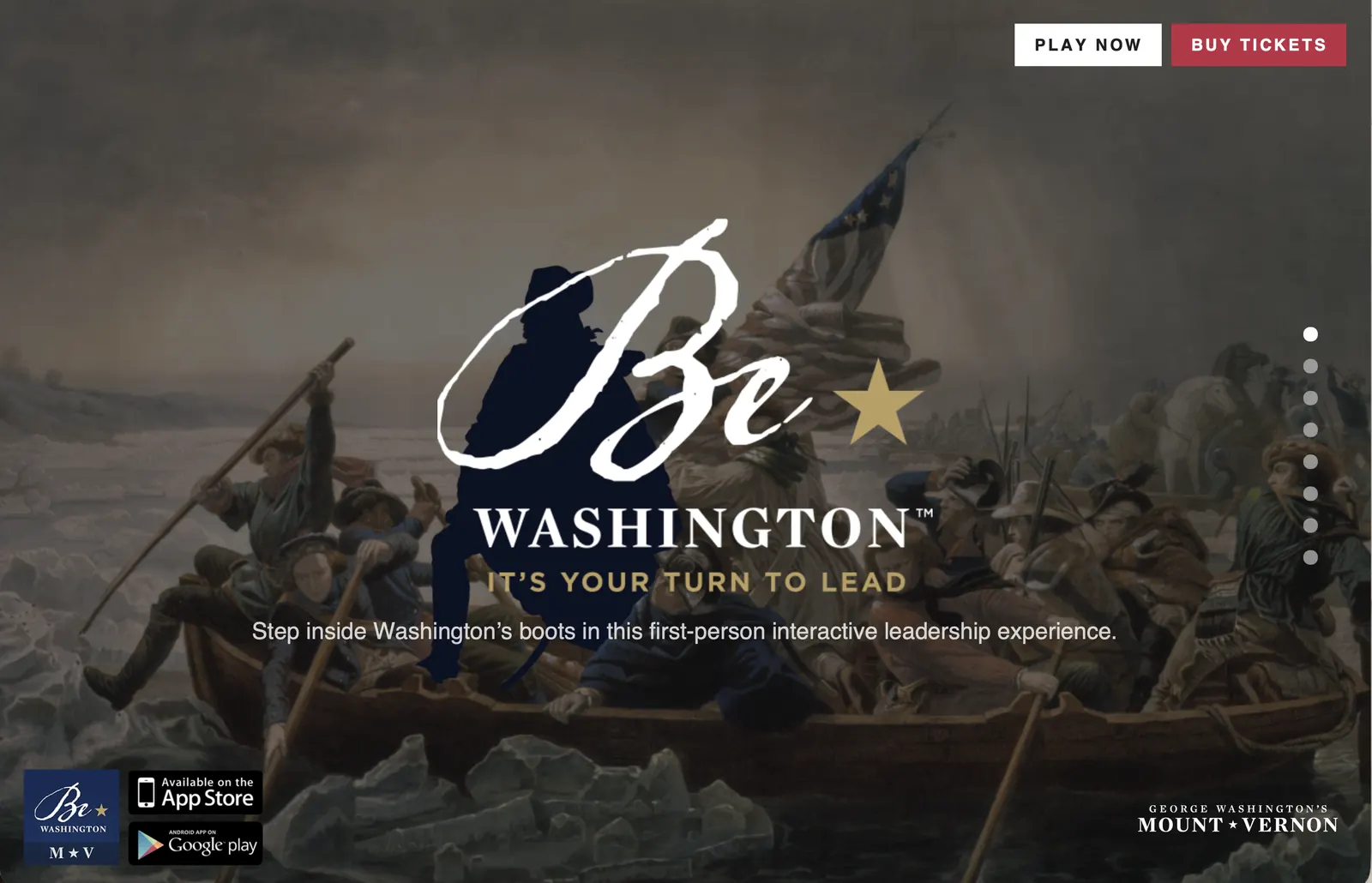
Be Washington: It’s Your Turn to Lead
A $3.5M, 36-seat permanent interactive theater that drops visitors into Washington’s shoes, hands them real historical inputs, and asks what they’d do — and a free, web-based companion that has now reached 10× more players in classrooms than the on-site theater has reached in person.
The brief
Build a permanent interpretive experience that does something most museum theaters can’t: actually puts visitors in the seat. Not a lecture, not a film — a chamber where you weigh real historical inputs, hear advisors argue, and make Washington’s decisions in his moment. Then turn that exact same experience into something a 7th-grade civics class can play on a Chromebook.
The theater experience
The on-site theater is a 36-seat chamber inside the Donald W. Reynolds Museum & Education Center, designed to feel like Congress Hall in Philadelphia. A 30-foot, 6K LED wall fills the front of the room. Each visitor has their own touchscreen desk — 18 of them in total, two players per desk.
Christopher Jackson — who played Washington in the original Broadway run of Hamilton — hosts every show, on-screen, guiding visitors through four real decision points from Washington’s life:
- The Battle of Second Trenton (1777) — do you stand and fight, or pull back?
- The Newburgh Conspiracy (1783) — how do you respond when your own officers threaten to march on Congress?
- The Genêt Affair (1793) — what do you do with a foreign minister stirring up a domestic faction against you?
- The Whiskey Rebellion (1794) — armed insurrection against a federal tax. What does a president do?
Washington’s most trusted advisers — Jefferson, Hamilton, Knox, and others — appear on the desks and argue each side. You rate how persuasive each is, vote on a decision, and the theater shows you what the room chose, what Washington actually did, and why.


On set


What we did
- Directed end-to-end creation of the $3.5M capital project — narrative, scripts, advisor recruitment, casting (including Christopher Jackson as host), set design, AV stack, and software.
- Anchored each scenario in primary-source research, with advisors’ arguments drawn from documented positions of the period.
- Built the real-time voting and reveal architecture, and the post-show debrief that connects visitor decisions back to the historical record.
- Shipped a companion online platform — identical experience, every word of media reused, with single-player and multi-player modes designed for classrooms.
- Partnered with Cortina Productions on media design and production, Gallagher & Associates on experience design, and Solomon Group on AV systems, fabrication, lighting, and Medialon show control.
Three ways to play
The experience travels in three formats — theater, classroom, and a private hosted session — that all play from the same media and the same decision architecture.
Interactive Theater
36 seats, 18 desks, a 30-foot 6K LED wall, and Christopher Jackson on-screen. On-site at Mount Vernon, free with admission.
At Home & in the Classroom
A web version with single-player and multi-player modes, free, no download. Where 10× of the audience actually plays.
Private Hosted Session
A live-hosted run of any scenario for corporate groups, leadership cohorts, or schools, on-site at Mount Vernon by appointment.
In the classroom — where the audience really is
The number that matters most isn’t the 36 seats. It’s the ratio: for every student or visitor who plays Be Washington on-site at Mount Vernon, ten more play it in a classroom or at home through the web version. The on-site theater earns the press and the Thea Award; the web version does the audience work.


Single-player and multi-player, on purpose
The web version has two modes that mirror the theater exactly:
- Single-player. A student plays one scenario alone — usually as homework or a flipped-classroom assignment. They hear the advisers, weigh the evidence, make a decision, and read Washington’s actual choice. Built to fit inside a class period.
- Multi-player. A teacher runs the room — phones or laptops vote in real time, the consensus animates on the front screen, and the class debates. It’s the theater experience, made of HTML.
Lesson plans, designed alongside the game
Each scenario ships with a full classroom resource: a primary-source packet, a teacher facilitation guide, discussion questions, vocabulary, an assessment rubric, and the in-game debrief. All free, all aligned to social-studies standards, all designed so a teacher who has never visited Mount Vernon can run a great class on Washington’s decision-making in one prep period.
Be Washington trailer
A 2-minute walkthrough of the experience — useful for teachers introducing the game to a class.
Recognition
“Be Washington is an excellent example of bringing historical education to life in a present-time environment.” — Thea Awards Committee
The Thea is the entertainment industry’s top recognition for immersive experiences, typically awarded to major theme-park attractions. Be Washington winning one in 2018 was a working argument that civic and historical content, given enough craft and risk, can compete with anything in the immersive-entertainment world. A year later, it picked up a Merit Award from the Society for Experiential Graphic Design.

Why it mattered
The theater is the part that wins awards. The web version is the part that does the work. Building both at the same time, with the same media and decision architecture, meant Mount Vernon got the press value of a major immersive attraction and the audience reach of a free educational platform — from a single capital investment. That’s a model the cultural-institution sector should steal more often.
Play Be Washington → Visit the theater →
Media gallery


