Case study · Mount Vernon · 2018 · Three Telly Awards
The Theater Where It Snows: A $3.5M Overhaul of Mount Vernon’s Revolutionary War 4D Theater
Mount Vernon’s second-most-visited attraction got a full reinvention — a brand-new 22-minute 4K original film (Washington’s War), a curved 32 × 16-foot screen, a 9.2-channel surround system, upgraded seat rumblers, new snow and fog, and strobes and gobos that turn film into weather. It won a 2018 Gold Telly and a pair of Bronzes.
The brief
For more than a decade, the Revolutionary War Theater was Mount Vernon’s second most-visited attraction — the place every visitor heard about before they arrived as “the theater where it snows.” By 2017, the original film and the original AV stack were both showing their age. The job: design a top-to-bottom reinvention — new film, new screen, new audio, new seat effects, new weather — without losing the moment that everyone remembered.
Washington’s War: a new original film, two years in the making
The heart of the overhaul is a brand-new 22-minute 4K original, produced with Wide Awake Films. It follows General Washington through the three campaigns that won the Revolution — Boston, Trenton, and Yorktown — combining live-action reenactment, 3D animated tactical maps, a sweeping score, and the kind of booming sound the room can carry.
Washington’s War — full 22-minute film
Production at scale
The shoot was a year-plus production effort:
- A cast of 200+ actors and historical reenactors.
- A 40-person crew on the ground.
- A battery of 18th-century artillery — reportedly the most cannons on set since the production of Last of the Mohicans.
- Filming across Virginia: Fuqua Farms (Richmond), Gadsby’s Tavern (Alexandria), Wellbourne House (Middleburg), Goose Creek Bridge, and Mount Vernon itself.


On set


The theater: a full sensory rebuild
The theater itself was rebuilt around the new film. Solomon Group led AV integration, scenic fabrication, lighting, and show control, partnered with Gallagher & Associates on experience design.
- Image. A new curved projection screen, ~32 ft × 16 ft, driven by a Christie Boxer 4K projector. The curve and the cleaner edges make the cannon fire feel like it’s coming at you.
- Sound. Upgraded to a 9.2-channel surround system, with cannon shots and musket volleys placed around the room rather than just in front of it.
- Seats. All-new seat rumblers tuned to the score and the artillery hits.
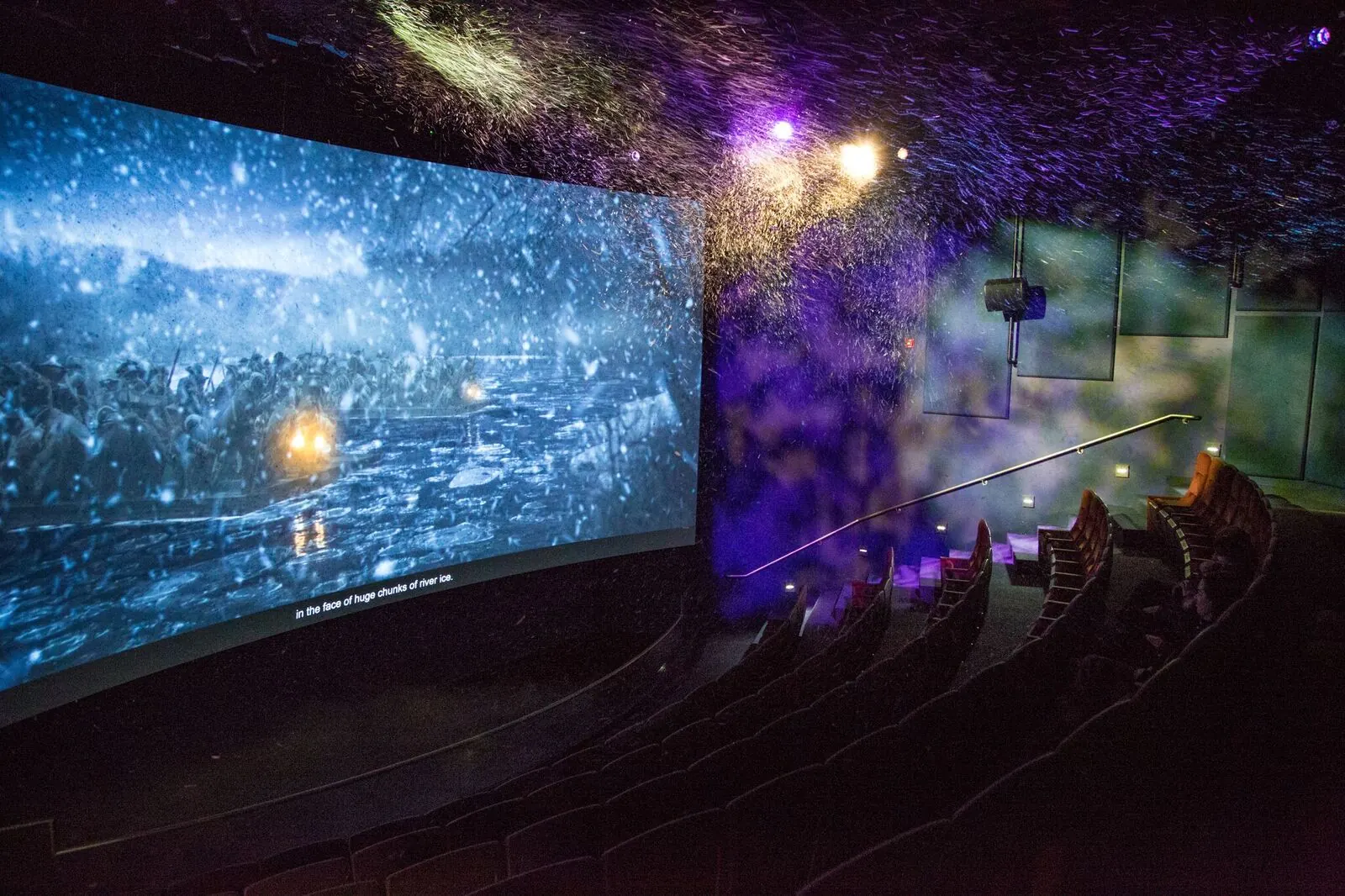
- Weather. A new snow and fog system — the moment everyone remembers — restaged with finer particle, better coverage, and tighter sync to the show.
- Lighting. New theatrical lighting fixtures with strobes and gobos that transform the room itself into part of the scene — a muzzle flash on stage becomes a strobe in the audience.
- Show control. A Medialon-based show control system synchronizes media, audio, seats, snow, fog, and lighting into a single 22-minute composition.


Recognition
The film and the theater together earned the project three Telly Awards in 2018:
Gold Telly · Non-Broadcast, General Education
Bronze Telly · 3D-Graphics / Animation, General Education
Bronze Telly · Cinematography, General Education
The trailer
A short version cut for ticketing and marketing pages:
Theater preview trailer
Why it mattered
Snow falling on an audience as Washington crosses the Delaware is a five-second moment that families remember for years. Earning that moment back, at a higher resolution — with a better story under it — was the whole job.
The Revolutionary War Theater is the kind of attraction that defines how a generation of visitors remembers Mount Vernon. Doing it right meant taking it apart entirely — new film, new room, new effects — while keeping the few specific things that made it special in the first place. The fact that the new version went on to a Gold Telly and pulled Washington’s War into the broader film series meant the capital investment paid off in two directions: a better on-site experience for paying visitors, and an award-winning original asset Mount Vernon could distribute on Amazon Prime, Apple TV, Google Play, and Curiosity Stream for years afterward.
Media gallery


