Case study · Theodore Roosevelt Presidential Library · July 2026
A Sitting President, a Medal of Honor, and 269,000 Views
Three days before a brand-new institution opened to the public, it hosted a presidential dedication — a White House press advance, a Secret Service footprint, a national press pool, and a ceremonial train, in a town that had never run a public event of any size. The five videos from that day have been watched 269,000 times.
The brief
A presidential visit is not a communications opportunity you accept. It is an operation you absorb, on someone else’s timeline, with your own opening three days away.
On July 1, 2026, President Trump came to Medora, North Dakota to dedicate the Theodore Roosevelt Presidential Library. That meant White House press advance working alongside an institutional comms shop that had existed for two years; a national press pool arriving in a town with no filing room; a Secret Service perimeter across a campus still finishing its punch list; and a building that had not yet admitted a single member of the public.
Two press operations with different objectives were sharing one site. The White House’s job was the President’s day. Ours was the Library’s next fifty years.
What actually happened
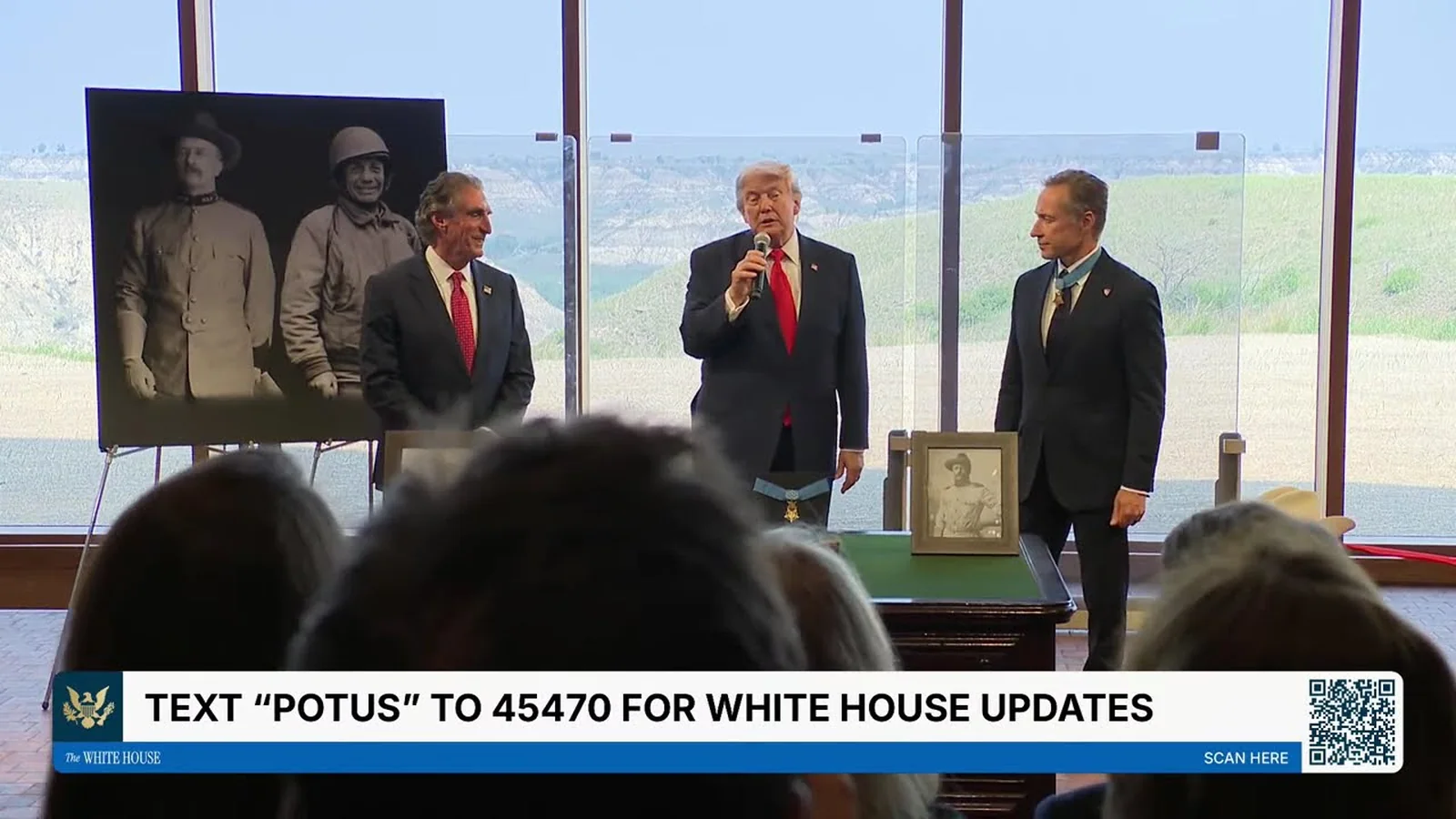
The President arrived in Medora by ceremonial train as part of the Freedom 250 program — following, more or less, the rails Roosevelt himself took west. He was introduced by Interior Secretary and former North Dakota governor Doug Burgum, and spoke at the Burning Hills Amphitheatre in front of Rough Rider reenactors.
Two announcements gave the day its news value beyond the visit itself:
- Theodore Roosevelt’s Medal of Honor was presented to the Library. It had been displayed in the Roosevelt Room of the White House; it now sits alongside the Medal of Honor awarded to Roosevelt’s son. Two generations of the same family, the same decoration, in the same case.
- A $750,000 commitment from the National Endowment for the Humanities toward the Library’s first year of operations.
The line the wires took: “Theodore Roosevelt reminds us all that to be a great nation, and to be a free nation, we must have courage. Without courage, you have nothing.”
Reuters also noted the trip debuted the new Air Force One — a reminder that when a President travels, your event is one of several stories sharing a dateline, and not necessarily the lead.
The dedication remarks
The full hour from Burning Hills Amphitheatre. The single most-watched video the Library has published — and a reminder that on days like this the institution’s own channel is a primary source, not a promotional one.
The exhibit that stole the news cycle
The most-reported detail of the visit was not the medal or the money. It was the President stopping to talk to the AI Theodore Roosevelt in the galleries.
Forbes had already published on the exhibit that morning. The Hill covered the conversation. The New Republic ran it under “People Think Trump Hallucinated Teddy Roosevelt. The Truth Is Weirder.”
None of that was planned as the story of the day, and it is the most useful thing I took from it: on a visit this size, your institution does not control the lead. What it controls is whether there is something in the building worth writing about when the pool camera swings away from the podium. We had spent two years building that thing for other reasons, and it paid off in a news cycle nobody scripted.


Advancing a visit you don’t control
The practical work divided into four problems, none of which are glamorous and all of which decide whether the day works.
Two press operations, one site
White House press advance runs to the President’s schedule and the pool’s requirements. Institutional comms runs to the building, the collection, the donors and the staff. Those overlap but do not align, and the overlap has to be negotiated in advance rather than discovered at 6 a.m. on the day — where the pool stands, what they can shoot, which rooms are closed, who speaks for the institution when a reporter asks a question the White House won’t answer.
Credentialing on a secured campus
A Secret Service footprint changes every assumption about access. Journalists who had been cleared for the Library’s own press tours were not automatically cleared for July 1, and the two lists had to be reconciled while the building was still being finished.
A dress rehearsal nobody asked for
The unexpected benefit: July 1 stress-tested every system three days before the public arrived. Shuttles, parking, crowd flow, the auditorium, the galleries under load, the livestream. Problems that would have surfaced on July 4 in front of 3,500 ticketholders surfaced on July 1 instead, in front of a press pool that was looking at the President.
Staying the institution
The hardest part is tonal. A presidential library is not a partisan organization, and the day it hosts a sitting President is the day that is easiest to forget. Every piece of copy the Library published that week had to work for an audience that included people delighted by the visit and people angered by it — and had to still read as an institution in fifty years, when the political weather has changed several times over.
The coverage was not uniform, and shouldn’t have been
The wires and the networks played it straight: AP, Reuters, the Washington Post, USA TODAY, PBS NewsHour and C-SPAN.
Others did not, and the criticism was substantive rather than reflexive. The Guardian and Outside both drew the contrast between the administration’s public-lands record and the president being honored — the man who put 230 million acres under federal protection. Buffalo’s Fire reported that the irony of the celebration “could not be sharper.”
That is a fair reading, and an institution dedicated to Roosevelt has no business pretending otherwise. The Library’s answer was not a rebuttal. It was the ceremony three days later, which opened with a blessing from the Mandan, Hidatsa and Arikara Nation, and a permanent exhibition that addresses Roosevelt’s record on race and empire directly rather than around it.
An institution that can only be visited by people who agree with each other is not a public institution.

What I’d carry forward
- Negotiate the overlap before the day. Two press operations on one site is a solvable problem at T-minus-two-weeks and an unsolvable one at 6 a.m.
- Publish your own record. The Library’s channel holds the full hour of remarks, unedited. On a contested day, being the primary source is worth more than any statement.
- Have something in the building worth finding. The AI exhibit generated more coverage than either announcement. You cannot script that, but you can make it possible.
- Treat the big day as a rehearsal. Everything that broke on July 1 was fixed before July 4.
- Write for the archive, not the news cycle. Every word published that week will still be attached to the institution long after the politics have turned over.
Why it mattered
269,000 views, same-day pickup on every major wire, and a Medal of Honor that moved from the White House to a museum case in the Badlands where it will stay.
But the number that matters is the one three days later: a sold-out public opening, and $98 million in earned media across 312 placements. The dedication was the loudest day. It was not the point of the week.
Video: POTUS Visit playlist. Broadcast frames as aired; behind-the-scenes photography my own. View counts as of August 2026.